
Have you ever noticed how you can walk into a room and immediately sense tension—even before anyone says a word?
Or perhaps you’ve found yourself tearing up while watching a complete stranger share their story. Maybe you’ve felt your heart ache when a friend was hurting, even though their experience was completely different from your own.
What if I told you there is actual science behind these experiences?
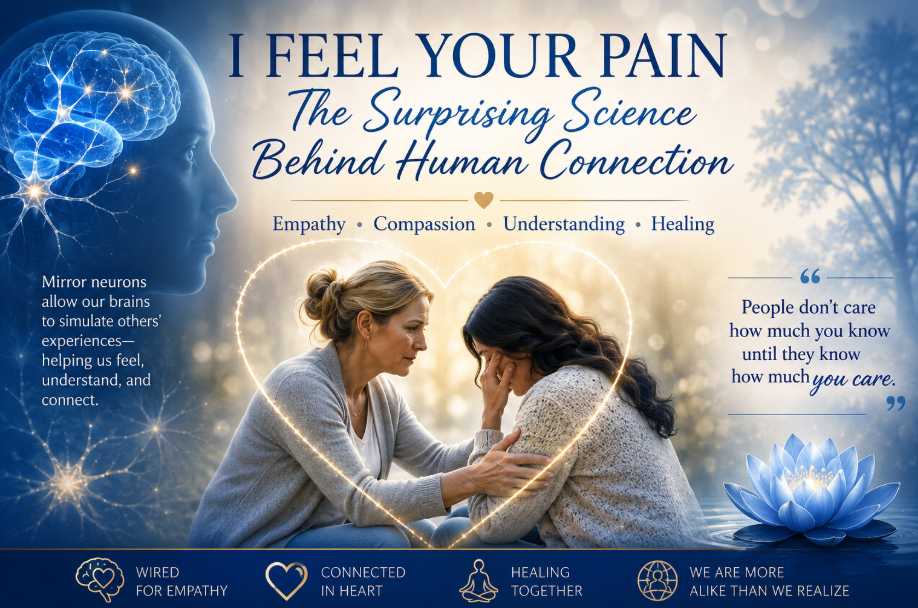
For years, researchers have studied what creates human connection, and the findings are fascinating. It turns out that we are wired for empathy far more deeply than most people realize. One of the most remarkable discoveries involves what scientists call mirror neurons. These specialized brain cells activate not only when we perform an action, but also when we observe someone else performing it. In a sense, our brains are constantly simulating the experiences of others.
When we see someone smile, our brain responds as if we are smiling. When we witness someone’s pain, parts of our brain associated with pain become active as well. While we may not literally feel another person’s suffering, our nervous system is designed to help us understand and relate to it.
In other words, empathy is not simply a moral virtue—it’s part of our biological design.
Why Empathy Matters More Than Ever
 Yet something interesting happens as we move through life.
Many of us become less connected to this natural ability. We become distracted, overwhelmed, judgmental, or absorbed in our own struggles. We begin to see people through labels, opinions, and assumptions rather than through our shared humanity.
Perhaps not surprisingly, studies show that empathy often declines during medical training. Without targeted interventions, care can become less compassionate and more transactional, leaving patients feeling unheard, unseen, and dissatisfied.
Unfortunately, I know many people who are playing a game of musical chairs with physicians because they feel rushed through appointments and long for providers who genuinely listen.
Early in my career, I worked with a neurosurgeon. I was always impressed by how much time he spent simply talking with patients.
When I asked him why, he told me something I never forgot: “Given the opportunity, patients will reveal important information if you simply listen.”
Like counseling and life coaching, healing often begins when someone feels heard. In medicine, I believe compassion should not be separate from healing—it is part of the treatment itself.
Dr. Helen Reiss, Associate Professor of Psychiatry at Harvard Medical School, has emphasized that empathy and self-compassion are essential components of effective healthcare. As she explains, medical professionals must first develop self-empathy in order to provide truly empathic care to others.
The Connection Between Emotional Intelligence and Compassion
This is where compassion becomes a conscious choice.
People often find it easier to empathize with situations they have personally experienced. It’s why someone who has endured grief often becomes more compassionate toward those who are grieving. Someone who has struggled financially may better understand another person’s hardship.
Life has a way of turning knowledge into wisdom.
But true empathy asks something more of us.
It invites us to care even when we don’t fully understand.
- We don’t have to walk the same path to offer kindness.
- We don’t have to share the same beliefs to show respect.
- We don’t have to agree with someone’s choices to acknowledge their pain.
This is one of the foundations of emotional intelligence and personal growth: learning to see
beyond our own experience and connect with others through compassion.
A Spiritual Truth About Human Connection
Perhaps one of the greatest spiritual truths is that beneath our differences, we are far more alike
than we realize.
Every person you meet is carrying a story you cannot fully see.
The cashier who seems distracted may be caring for a sick loved one.
The friend who seems distant may be struggling with anxiety.
The stranger who appears angry may be carrying wounds that have never healed.
When we remember this, judgment softens and compassion grows.
Science tells us that we are biologically connected.
Spiritual wisdom tells us that we are all part of something greater than ourselves.
Both point to the same truth:
Human beings heal in connection.
A kind word can change someone’s day.
A listening ear can ease someone’s burden.
A moment of genuine understanding can remind a person they are not alone.
In a world that often feels divided, rushed, and noisy, empathy may be one of the most powerful
gifts we can offer.
Not because we fully understand another person’s journey.
But because we are willing to walk beside them for a while.
A Moment for Reflection
This week, consider asking yourself:
Who in my life might simply need to be heard?
Then offer them one of the most healing gifts available:
Your presence.
Your attention.
Your compassion.
Because sometimes the most powerful words we can say are not: “I understand.”
They are: “I may not know exactly what you’re going through, but I care.”
Final Thoughts
Whether through life coaching, emotional healing, spiritual growth, or simply learning to be more
present with others, empathy has the power to transform lives.
As the saying goes: “People don’t care how much you know until they know how much you care.”
And perhaps that is the deepest lesson of all.
Recent Comments